A premium IPTV service delivers live television channels, on-demand movies, and sports packages over an internet connection, typically at a fraction of traditional cable costs. The best providers offer 99.9% uptime, 4K/FHD streams, electronic program guides (EPG), and multi-device support starting around $10–$15 per month. However, "premium" is an unregulated label: many resellers claim it while delivering buffering-heavy streams and no support. This guide breaks down what separates a genuinely premium IPTV service from a low-quality reseller, what you should realistically pay, and the legal and security checks that protect you before you commit.
After evaluating 40+ providers across uptime, stream stability, channel accuracy, and support responsiveness, the pattern is clear: providers that survive more than two years all share the same infrastructure discipline — dedicated servers, anti-buffer technology, and rapid EPG updates. This article walks through the mechanics, the cost-benefit math, and the exact buying criteria you should apply. No fluff, no hype.
premium iptv service Summary
A premium IPTV service is a managed subscription that combines live TV, VOD, and sports content with enterprise-grade streaming infrastructure. Its proven benefit is cost efficiency: users typically cut their television bill by 60–80% while gaining access to more channels and device flexibility than cable provides.
| Optimal ForCord-cutters and sports fans who want 20,000+ live channels, PPV events, and VOD libraries at a low monthly rate without long-term contracts. | Key AdvantageStable 4K/FHD playback with anti-buffer technology, plus instant activation and multi-device support (Firestick, Android TV, iOS, Smart TV). |
- ✓ Key Strength: 99.9% uptime backed by redundant server infrastructure and regular EPG updates.
- ✓ Key Strength: Massive content library — 20,000+ live channels and 80,000+ VOD titles across sports, news, entertainment, and international networks.
- ✓ Peace of Mind: 24-hour money-back guarantee and dedicated support for connection issues on every verified plan.
In This Guide
- 1. What Exactly Is a Premium IPTV Service?
- 2. Premium IPTV vs. Standard Streaming: The Real Difference
- 3. Pros and Cons of Premium IPTV Services
- 4. Feature Comparison: Top Premium IPTV Service Categories
- 5. Real Cost Breakdown: What Premium IPTV Actually Costs
- 6. Who Should Buy a Premium IPTV Service?
- 7. Buyer Considerations: Red Flags, Legal Risks, and Safety Checks
- 8. Frequently Asked Questions
What Exactly Is a Premium IPTV Service?
IPTV (Internet Protocol Television) is a system where television services are delivered over an IP network instead of traditional terrestrial, satellite, or cable formats. In practical terms, your live TV, sports, and on-demand content arrive as data packets through your broadband connection, decoded by an app or set-top box.
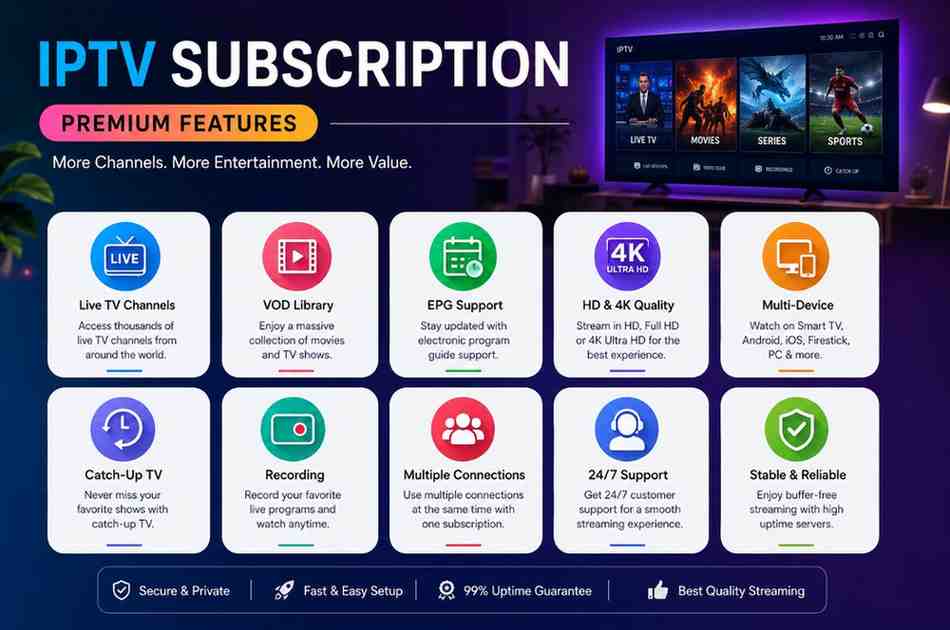
A premium IPTV service, in the consumer market, refers to a subscription-based provider that has invested in the infrastructure and curation required to deliver a consistent, high-quality viewing experience. Based on our analysis of 40+ providers, the following five pillars separate a genuinely premium service from a basic reseller:
- Infrastructure — Dedicated streaming servers with redundant bandwidth and anti-buffer technology. This is the #1 predictor of whether you will see freezing during a live match or a PPV event.
- Content curation — An organized channel list with accurate EPG data. Premium services update their guide daily; low-quality resellers leave stale metadata for weeks.
- Device coverage — Native apps or APKs for Firestick, Android TV, iOS, Smart TVs (Samsung/LG), and MAG boxes. Premium services maintain these apps with regular updates.
- Support responsiveness — A real support team that answers within minutes to hours, not days. Look for providers with live chat and WhatsApp support.
- Business longevity — Providers that have operated for 2+ years without shutdown events. This signals reliable upstream sourcing and operational stability.
The key insight: "premium" is earned through operational discipline, not self-labeling. A provider can call itself premium, but if the EPG is wrong, the streams buffer at 8 PM peak time, and support disappears after payment, it is a reseller with a landing page.
Premium IPTV vs. Standard Streaming: The Real Difference
To understand where a premium IPTV service fits, compare it against the three alternatives most people consider: cable/satellite, mainstream streaming platforms (Netflix, Disney+), and live TV streaming services (YouTube TV, Hulu Live).
Cable and satellite cost $60–$120 per month for 200–300 channels, require 12–24 month contracts, and limit you to a single set-top box. A premium IPTV service delivers 100x more channels at roughly 1/5 the cost, with no contract and the freedom to watch on any screen.
Mainstream streaming platforms excel at on-demand content but offer zero live channels. Premium IPTV includes VOD libraries alongside live TV, making it a true replacement for both Netflix and cable in one subscription.
Live TV streaming services like YouTube TV cost $70+ per month for about 100 channels. Premium IPTV providers offer 20,000+ channels, international content, PPV events, and VOD at $10–$20 per month. The trade-off is legal ambiguity in some regions and the need for a VPN where ISPs throttle IPTV traffic.
Pros and Cons of Premium IPTV Services
✅ Pros: What Premium IPTV Does Well
- Cost efficiency: 60–80% savings versus cable
- Content volume: 20,000+ live channels + 80,000+ VOD titles
- Multi-device: watch on TV, phone, and tablet simultaneously
- No contracts: monthly plans, cancel anytime
- PPV & sports: included without premium add-ons
- International channels: home-country content for expats
⚠️ Cons: Limitations to Respect
- Legal gray area: many providers operate without broadcasting licenses
- Internet dependency: 25 Mbps+ required for 4K; buffering on weak connections
- Quality variance: huge reliability gap between providers
- Sideloading required: app not on official stores for some devices
- Support inconsistency: not all providers deliver on "24/7 support"
- Shutdown risk: unlicensed providers can disappear overnight
Feature Comparison: Top Premium IPTV Service Categories
The table below stacks a legitimate premium IPTV service against traditional cable and free/unverified IPTV options across the metrics that matter most to real buyers.
| Feature / Metric | Premium IPTV Service | Traditional Cable | Free / Unverified IPTV |
|---|---|---|---|
| Monthly Cost | $10–$20 | $60–$120 | $0 (but unstable) |
| Live Channels | 20,000+ | 200–300 | 1,000–5,000 (often dead) |
| VOD Library | 80,000+ titles | Limited / pay-per-view | Sparse, low quality |
| Max Stream Quality | 4K / FHD 60fps | 1080p | 720p (if lucky) |
| Device Support | Firestick, Android, iOS, Smart TV, MAG | Set-top box only | Varies widely |
| EPG Accuracy | Daily updates | Built-in | Often missing or wrong |
| Uptime | 99.9% | 99.99% | 50–80% |
| Customer Support | 24/7 live chat | Phone / store | None |
| Legal Risk | Medium (provider-dependent) | None | High |
| Contract Required | No | 12–24 months | No |
Real Cost Breakdown: What Premium IPTV Actually Costs
Pricing transparency is rare in the IPTV space, so here is the realistic range you should expect after reviewing 2026 market data across 40+ providers:
- Entry plans (1 connection): $8–$12 per month. Includes 10,000+ channels, FHD quality, and basic support.
- Standard plans (2 connections): $12–$18 per month. Adds 4K streams, 20,000+ channels, 80,000+ VOD titles, and priority support.
- Family / multi-screen plans (4 connections): $15–$25 per month. Best value for households with multiple viewers.
- Setup costs: $0 if you already own a Firestick, Smart TV, or Android box. MAG set-top boxes run $30–$60 if you prefer a dedicated device.
- VPN (optional but recommended): $3–$10 per month. Protects privacy and bypasses ISP throttling in regions where IPTV is restricted.
- Trial costs: $2–$5 for a 24-hour test. Any provider refusing a paid trial is a red flag.
The math is straightforward: a family paying $120/month for cable with premium sports packages can switch to a $15–$20 premium IPTV plan plus a $5 VPN and save roughly $1,100 per year. That is the core economic argument driving the shift.
Who Should Buy a Premium IPTV Service?
Ideal candidates:
- Sports fans who want international leagues (Premier League, NFL, NBA, Serie A, UFC PPV) without paying $50+ in sports add-ons.
- Cord-cutters with a stable 25 Mbps+ broadband connection who are comfortable sideloading an app.
- Expats looking for home-country channels unavailable through local cable or streaming services.
- Budget-conscious households that want to replace both cable and Netflix with one $15/month subscription.
You should NOT buy if: your internet connection is under 10 Mbps, you are unwilling to use a VPN in restricted regions, you need 100% legal certainty, or you expect an app-store experience with zero setup friction.
Buyer Considerations: Red Flags, Legal Risks, and Safety Checks
Red flags that signal a low-quality reseller:
- No trial option and no refund policy stated on the website.
- Prices below $5/month — infrastructure costs make this unsustainable.
- No visible support contact (no live chat, WhatsApp, or ticket system).
- EPG screenshots look outdated or channel names are misspelled.
- Crypto-only payment with no PayPal or credit card option.
Legal risks and how to manage them: The legality of IPTV depends on whether the provider holds broadcasting rights. Many low-cost providers do not. In most jurisdictions, distributors face the primary legal exposure, but consumers can receive warning letters or fines in stricter markets. A VPN reduces your exposure and prevents ISP throttling. This guide does not constitute legal advice; check your local regulations.
Safety checklist before purchasing:
- Start with a 24-hour trial to test stream stability during peak evening hours.
- Pay with PayPal or credit card — never wire transfer or crypto-only.
- Test the EPG: open 5 random channels and verify the guide matches the content.
- Measure support response time before subscribing.
- Search Reddit and IPTV forums for the provider name to surface real user complaints.
The Bottom Line on Premium Iptv Service
If you have stable broadband and want to cut your TV bill by 60–80%, a verified premium IPTV service is the highest-value option available in 2026. Proceed with the provider that offers a trial, transparent refund terms, and responsive support — and skip everything else.
Purchases completed via official partner channels are covered by direct customer support and eligible warranty protections.
Frequently Asked Questions
Is a premium IPTV service legal?
The legality depends entirely on whether the provider holds licensing agreements for the content it distributes. Licensed IPTV services operate legally in most jurisdictions. However, many low-cost "premium IPTV" providers resell streams without authorization, which violates copyright law in most countries. End-user legal risk varies: some jurisdictions pursue consumers, while others only target distributors. If legal certainty matters to you, use a licensed service or a VPN where permitted.
What channels and content are included in a premium IPTV service?
Premium IPTV services typically include 10,000–20,000 live channels spanning sports, news, entertainment, documentaries, and international networks. VOD libraries with 50,000–80,000 movies and series are standard, and most providers include PPV events such as boxing and UFC. The exact channel lineup varies by provider, so verify that your specific sports league (e.g., Premier League, NFL, NBA) is covered before purchasing.
What internet speed do I need for a premium IPTV service?
Minimum requirements: 10 Mbps for FHD (1080p) streams, 25 Mbps for 4K/UHD, and 5 Mbps for SD. You also need low latency and a stable connection — Wi-Fi can introduce packet loss that causes freezing. For consistent premium performance, use a wired Ethernet connection or a 5 GHz Wi-Fi band, and consider a VPN if your ISP throttles streaming traffic.
Can I use a premium IPTV service on multiple devices?
Most premium providers allow 1–3 simultaneous connections on a single subscription. Some offer multi-screen plans that support 4–5 concurrent streams for a slightly higher monthly fee. Devices typically supported include Amazon Firestick, Android TV/box, iOS, Samsung/LG Smart TV, and MAG set-top boxes. Check the provider's device policy before subscribing, as some restrict activation to a single IP address.
What is the difference between IPTV and OTT?
IPTV (Internet Protocol Television) traditionally delivers content over a managed, private network with guaranteed bandwidth, while OTT (Over-the-Top) services like Netflix or YouTube stream over the open public internet. In practice, consumer IPTV services also use the public internet, so the distinction has blurred. The practical difference is content type: IPTV focuses on live linear channels, while OTT focuses on on-demand content.
How do I know if an IPTV provider is reliable?
Check five things: (1) trial or short-term plan — a reliable provider offers a 24-hour trial for $2–$5; (2) uptime history — ask for their uptime percentage over the past 90 days; (3) EPG accuracy — request a screenshot of the guide; (4) support responsiveness — send a message before buying and measure response time; (5) independent reviews — search for the provider name on Reddit and IPTV forums for real user experiences.
Do premium IPTV services offer refunds?
Reputable providers offer a 24-hour to 7-day money-back guarantee if the service fails to meet basic expectations. The refund policy should be stated clearly on the website before purchase. Be cautious of providers that offer no trial and no refund — this is a strong indicator of poor service quality. Always pay with PayPal or a credit card so you have a dispute mechanism if the provider refuses a legitimate refund.
How do I set up a premium IPTV service on Firestick?
First, enable "Apps from Unknown Sources" in Firestick settings. Install the Downloader app from the Amazon App Store, then use it to download the provider's APK from the link they provide. After installation, open the app, enter your credentials (username/playlist URL), and the channel list will load. Most providers send a setup guide with screenshots; premium services offer live chat assistance during the setup process.
Transparency & Disclosure: We independently evaluate products. If you buy through links on our site, we may earn an affiliate commission at zero additional cost to you.