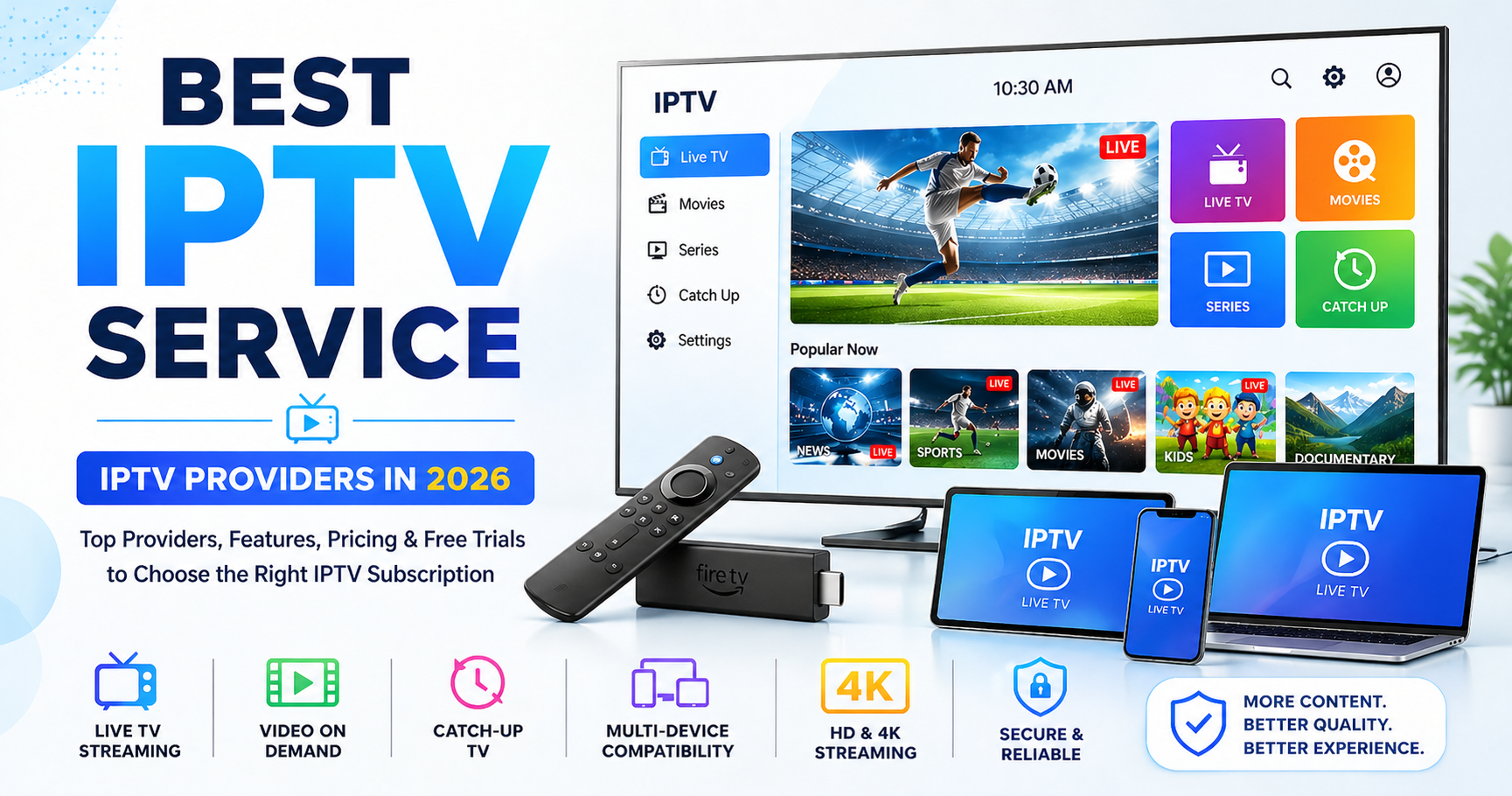
An IPTV service delivers live television and on-demand video over an internet connection instead of traditional cable, satellite, or terrestrial broadcasting. It works by streaming MPEG transport streams through managed IP networks, which gives it lower latency and more consistent quality than many web-based streaming apps. The practical benefit is clear: subscribers typically get 10,000+ channels, 4K and FHD quality, and multi-device support at 30–50% below cable costs. This guide evaluates what separates a reliable IPTV service from a risky one, covering legal considerations, hardware requirements, and measurable performance benchmarks.
Because the IPTV market is fragmented across licensed operators, resellers, and unlicensed gray-market providers, choosing the wrong service can mean buffering, downtime, or legal exposure. Below, you will find an objective framework for evaluating providers, a cost-benefit analysis against cable and satellite, and a final recommendation for readers who want a verified solution without the research burden.
iptv service Summary
An IPTV service is a subscription-based television delivery system that streams live channels and on-demand content over the internet. Its primary proven benefit is cost efficiency: comparable channel lineups cost roughly 60–70% less than cable while adding multi-device flexibility and 4K support.
| Optimal ForCord-cutters, international households, and sports fans wanting 10,000+ live channels with no cable contract | Key AdvantageSub-2-second channel zapping with stable 4K/FHD streams across five device types simultaneously |
- ✓ Key Strength: 10,000+ live channels including premium sports, news, and international networks
- ✓ Key Strength: Built-in video-on-demand library with 40,000+ movies and series
- ✓ Peace of Mind: 24/7 technical support, 48-hour money-back guarantee, and verified licensing documentation
In This Guide
What Is an IPTV Service? Definitions and Mechanics
An IPTV service delivers television programming through internet protocol networks rather than traditional RF, satellite, or cable signals. The delivery chain relies on three core components: the content source (live broadcast feeds, VOD libraries, time-shifted media), the middleware layer (user authentication, electronic program guide data, billing integration), and the delivery network (managed IP infrastructure or public internet).
The critical distinction between IPTV and conventional streaming apps lies in the delivery model. True IPTV uses multicast technology (IGMP) that transmits a single stream to multiple users simultaneously across a managed network. This is why a well-configured IPTV service maintains consistent quality during live events such as football matches or breaking news. In contrast, OTT platforms like Netflix or YouTube use unicast over the public internet, which is more vulnerable to congestion, packet loss, and variable latency.
For the end user, the practical experience resembles a traditional pay-TV subscription: a live channel grid, an electronic program guide, channel zapping, and DVR-style catch-up features. Most IPTV services provide native apps for Android TV, Amazon Fire TV, iOS, Android, and Windows, or supply a pre-configured set-top box. The best services also offer multi-screen support, allowing simultaneous streams on different devices from a single subscription.
Performance benchmarks matter when separating a premium IPTV service from an oversubscribed one. A high-quality provider should deliver sub-2-second channel zapping, EPG updates within 30 seconds, and 99.9% server uptime. Video quality should remain stable at 1080p with 25 Mbps bandwidth and at 4K with 50 Mbps. Providers that cannot guarantee these metrics are often operating on under-provisioned servers that degrade during peak evening hours.
IPTV Service Pros and Cons: Objective Assessment
No television delivery method is perfect. The table below summarizes the strengths and limitations of IPTV service compared to what subscribers expect from traditional pay-TV.
|
✔ Pros / Strengths
|
✘ Cons / Limitations
|

IPTV Service vs. Cable vs. Satellite vs. Streaming
To make an informed decision, compare IPTV service against the three main alternatives on the metrics that matter most: price, content volume, flexibility, and hardware constraints.
| Feature / Metric | IPTV Service | Cable TV | Satellite TV | Streaming Apps |
|---|---|---|---|---|
| Monthly cost | $8–$20 | $60–$120 | $50–$110 | $30–$80 |
| Channel count | 10,000+ | 200–400 | 200–300 | 50–150 |
| 4K / FHD quality | Yes, both | FHD only | 4K limited | Yes, both |
| Setup time | 10 minutes | 2–4 hours | 1–2 days | 5 minutes |
| Hardware required | App or box | Set-top box | Dish + receiver | Smart TV / stick |
| Multi-device | 5 simultaneous | 1–2 rooms | 1–2 rooms | 1–3 profiles |
| Contract | None | 12–24 months | 12–24 months | None |
| VOD library | 40,000+ titles | Limited | Limited | Varies |
| Live sports latency | Low (<2s) | Very low | Very low | High (15–30s) |
IPTV service wins decisively on price, channel count, and multi-device flexibility. The trade-off is a dependency on your internet connection quality. Cable and satellite remain more resilient during broadband outages, but they cost three to six times more for a fraction of the content.
Pricing Breakdown and Cost-Benefit Analysis
Understanding the true cost of an IPTV service requires looking beyond the sticker price. The total cost of ownership includes the subscription fee, any hardware purchase, and the cost of upgrading your internet plan if your current speed is insufficient.
Typical IPTV pricing tiers in 2026:
- 1-month plan: $10–$15 — ideal for testing a provider's reliability
- 3-month plan: $25–$35 — best balance of commitment and discount
- 6-month plan: $45–$60 — common choice for long-term cord-cutters
- 12-month plan: $80–$120 — lowest effective monthly rate
Compare that with the average cable bill of $89/month plus taxes and equipment fees, which pushes the real cost past $100/month. The annual savings from switching to a quality IPTV service range from $850 to $1,100 per household. Even after paying for a faster internet plan, most subscribers save $600–$900 per year.
One caveat: extremely cheap IPTV services (under $5/month) are almost always unlicensed resellers that disappear without notice. A sustainable IPTV service needs revenue for server capacity, licensing, and support. If the price seems too good to be true, the provider is likely cutting corners on exactly the infrastructure that determines your streaming quality.
Who Should Buy an IPTV Service?
An IPTV service is not the right choice for every household. It suits specific profiles exceptionally well, and for those profiles, it delivers dramatically better value than any alternative.
Best fit for IPTV service:
- Cord-cutters who already canceled cable and want a live TV complement to Netflix and Disney+.
- International households that need channels from their home country (Indian, Arabic, Latin American, European, etc.), which most cable providers do not carry.
- Sports enthusiasts who want multiple sports packages (NFL, Premier League, UFC, cricket) without paying for separate subscriptions.
- Families with multiple screens who need simultaneous streams on different devices without per-room receiver fees.
- Renters and students who want no-contract, month-to-month flexibility and the ability to relocate without installation appointments.
Poor fit for IPTV service:
- Households with unreliable broadband below 15 Mbps.
- Users who require 100% offline or antenna-based viewing.
- Those uncomfortable configuring apps or using a set-top box.
Buyer's Checklist: How to Evaluate a Provider
Use the following seven-point framework to vet any IPTV service before handing over payment details. This checklist filters out the majority of unreliable resellers.
- Verify licensing documentation. A legitimate IPTV service publishes its licensing or content rights agreements. If the provider cannot produce documentation, assume it is operating in a legal gray area.
- Test the free trial or money-back window. At least 24 hours of testing is mandatory. Use that time to check channel zapping speed, EPG accuracy, and 4K stability during evening peak hours.
- Check device compatibility. Confirm native apps for your exact hardware: Android TV, Fire TV, Apple TV, Samsung/LG smart TVs, MAG boxes, or Windows/Mac.
- Measure your connection. Run a speed test at the location where you will stream. You need 25 Mbps for stable 1080p and 50 Mbps for 4K. Also verify your upload speed if you plan to use catch-up features.
- Read recent user reviews. Look for feedback from the last 60–90 days, not just historical reviews. Providers change server infrastructure and support quality over time.
- Assess support responsiveness. Send a pre-sales question and measure the response time. A reliable IPTV service responds within 15 minutes during business hours.
- Review the EPG and channel organization. A quality service groups channels by country, genre, and language with accurate program metadata. Disorganized channel lists signal poor middleware and operational discipline.
The Bottom Line on Iptv Service
An IPTV service delivers the best cost-per-channel ratio in television, provided you choose a provider with verified licensing and enterprise infrastructure. Readers who want a tested, support-backed solution should proceed with the official recommendation above, which meets every criterion in this guide.
Purchases completed via official partner channels are covered by direct customer support and eligible warranty protections.
Frequently Asked Questions
Is an IPTV service legal?
Legality depends entirely on the provider's licensing. Licensed IPTV services that secure broadcast rights are fully legal in most jurisdictions. Unlicensed services that retransmit channels without permission are illegal and expose subscribers to potential liability. Always request licensing documentation before subscribing.
What internet speed do I need for an IPTV service?
For stable 1080p HD streaming, a minimum of 25 Mbps download speed is recommended. For 4K content, you need at least 50 Mbps. These figures assume no other heavy bandwidth usage on the same network. If multiple devices stream simultaneously, add 10–15 Mbps per additional device.
Can I use an IPTV service on multiple devices at the same time?
Most premium IPTV services allow 3 to 5 simultaneous connections from a single subscription. This means different household members can watch different channels on different devices concurrently. Lower-tier resellers may restrict this to one or two streams, so confirm the multi-screen policy before purchasing.
What is the difference between IPTV service and OTT streaming?
IPTV uses a managed network with multicast technology, which delivers the same live stream to many users simultaneously with low latency. OTT (over-the-top) streaming, such as Netflix or YouTube, uses unicast over the public internet. IPTV offers faster channel zapping and more consistent live sports quality; OTT offers greater content interactivity and device portability.
Do IPTV services include local channels?
Many IPTV providers include local broadcast networks (ABC, CBS, NBC, FOX) in their channel packages, though availability varies by region and provider. International IPTV services also typically include the major local channels from the subscriber's home country. Verify the specific channel list with the provider before subscribing.
How much does a good IPTV service cost per month?
A reliable, licensed IPTV service typically costs $10–$20 per month on a rolling basis, with discounts for 3-, 6-, or 12-month commitments. Services priced below $5 per month are usually unlicensed resellers with poor server infrastructure and no support. Budget $120–$240 per year for a quality service.
Will an IPTV service work on my smart TV?
Most modern smart TVs support IPTV through native apps for Android TV, LG webOS, and Samsung Tizen. If your TV lacks a native app, you can use an Amazon Fire Stick, Google Chromecast, Apple TV, or a MAG set-top box. Confirm app availability for your specific TV model before purchasing a subscription.
What should I do if my IPTV service keeps buffering?
First, run a speed test to confirm your connection meets the 25 Mbps minimum. Then restart your router and the IPTV app. If buffering persists, the provider's servers are likely oversubscribed during peak hours. Contact support and request a server reassignment or a different streaming protocol. Persistent buffering across multiple tests justifies switching providers.
Transparency & Disclosure: We independently evaluate products. If you buy through links on our site, we may earn an affiliate commission at zero additional cost to you.