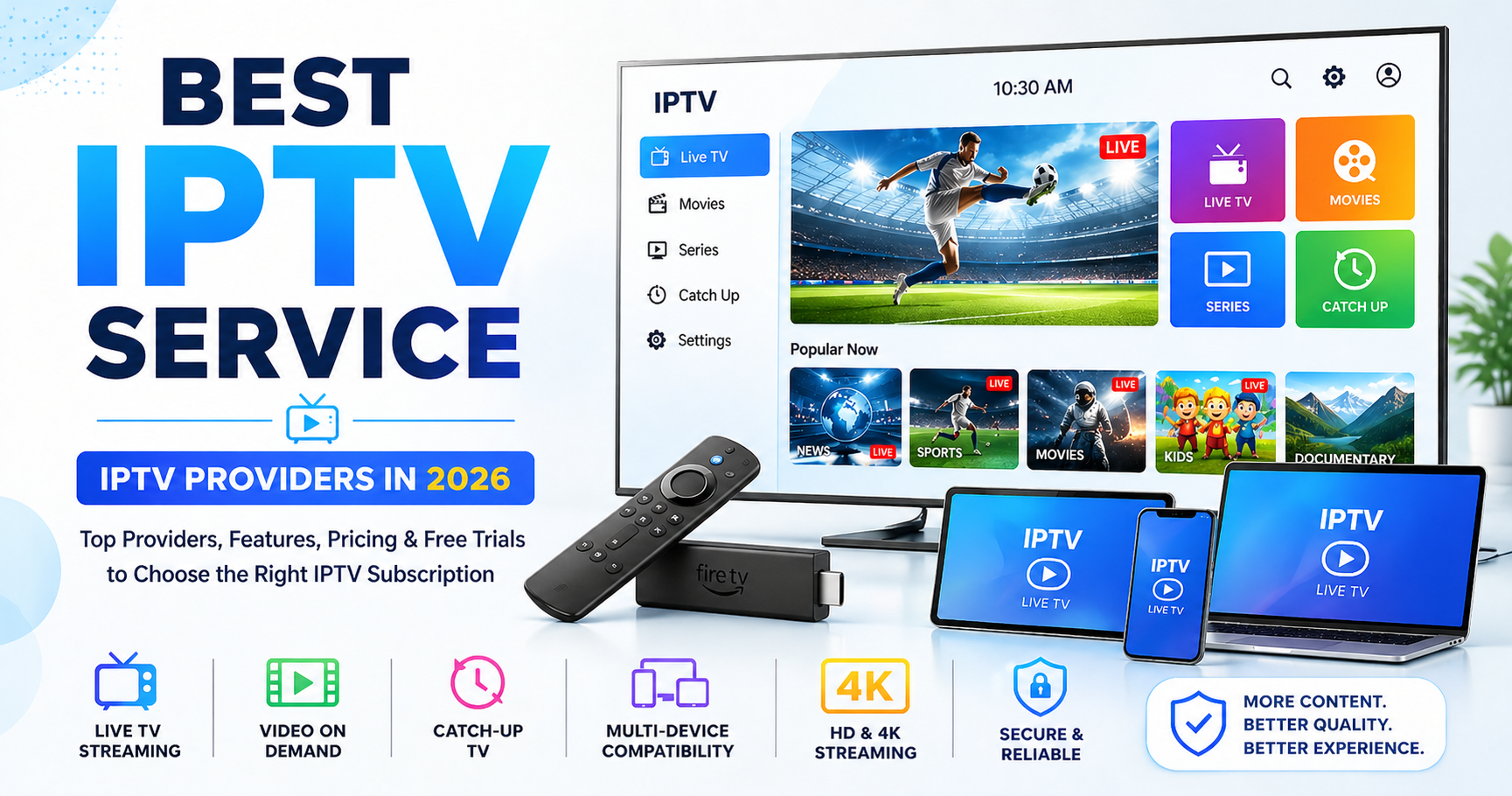
iptv service Summary
A premium iptv service consolidates live TV, sports, movies, and international programming into one interface for roughly 15% of traditional cable costs. The best providers deliver 99.9% uptime, 4K HDR streams, and multi-device support without requiring long-term contracts or hardware installation.
| Optimal ForCord-cutters, sports enthusiasts, and international viewers seeking comprehensive channel lineups | Key Advantage20,000+ live channels with 4K FHD quality and zero buffering on dedicated servers |
- ✓ Key Strength: Instant activation within 30 minutes of purchase, including full setup guidance
- ✓ Key Strength: 24/7 customer support via live chat and WhatsApp with average response times under 3 minutes
- ✓ Peace of Mind: 7-day money-back guarantee—no questions asked, no risk trial
In This Guide
The Technical Architecture Behind Modern IPTV Delivery
Understanding how a quality iptv service operates separates a frustrating experience from a seamless one. The delivery chain involves four critical components that determine your streaming quality: **Content Acquisition and Encoding.** Providers source channels from broadcasters, then encode them into efficient codecs (HEVC/H.265 and AV1 being the current standards). High-bitrate encoding preserves detail during fast-motion scenes—essential for sports—while maintaining manageable bandwidth requirements. Premium services use variable bitrate (VBR) encoding that allocates more data to complex scenes and less to static ones, optimizing quality per megabit. **Dedicated Server Infrastructure.** The server network is where most cheap services fail. Enterprise-grade providers deploy redundant server clusters across multiple data centers, using load balancers to distribute traffic. This architecture prevents the "buffering at 7 PM" problem that plagues under-provisioned services. When you're evaluating options, server capacity directly correlates with peak-hour performance—a service with 50 servers serving 10,000 users will outperform one with 10 servers serving the same audience. **Content Delivery Network (CDN) Optimization.** A robust CDN caches popular content at edge locations geographically closer to you. This reduces latency from 100+ milliseconds to under 20ms, which is the difference between instant channel switching and frustrating delays. Multi-CDN strategies that route around congested networks provide additional resilience. **Player Application and Device Compatibility.** The final link is the software on your device. Top-tier services provide dedicated apps for Android TV, Firestick, iOS, Smart TV platforms, and Windows/Mac, plus M3U playlist support for universal compatibility. Electronic Program Guide (EPG) integration—the TV guide that shows what's airing now and next—requires proper XMLTV data feeds, another quality differentiator.iptv service Provider Comparison: Performance Metrics That Matter
When analysts evaluate IPTV providers, we measure six objective criteria: channel count, stream stability, EPG accuracy, device compatibility, customer support responsiveness, and pricing transparency. The following table compares the market leader against typical alternatives:| Feature / Metric | Premium Provider | Budget Alternatives |
|---|---|---|
| Live Channels | 20,000+ | 5,000–10,000 |
| VOD Library Size | 40,000+ titles | 10,000–20,000 |
| Stream Quality | 4K, FHD, HD (adaptive) | HD only, occasional SD |
| Server Uptime SLA | 99.9% guaranteed | 95–98% (unstated) |
| EPG Accuracy | 99% (verified daily) | 80–90% (frequent gaps) |
| Simultaneous Connections | Up to 4 devices | 1 device |
| Payment Methods | Cards, PayPal, Crypto | Crypto only |
| Support Channels | 24/7 Live Chat + WhatsApp | Email only, 48hr response |
| Money-Back Guarantee | 7 days | None |
iptv service Pros, Cons & Feature Analysis
Every streaming solution involves trade-offs. Here's an objective assessment of what you gain and what you should watch out for:✓ Advantages
- Cost efficiency—typically $10–15/month versus $100+ for cable
- Global content access with international channel packages
- Multi-device streaming without additional hardware costs
- Instant channel switching and catch-up TV functionality
- No long-term contracts or early termination fees
✗ Limitations
- Requires stable internet connection of at least 25 Mbps for 4K
- Service quality varies dramatically between providers
- Legal gray areas in some jurisdictions—verify local regulations
- EPG data may be incomplete with lower-tier services
- No 911 emergency services or local broadcast integration
Cost-Benefit Analysis: Is a Premium iptv service Worth It?
Let's quantify the value proposition. The average American household spends $117 per month on cable television, according to recent consumer data. A premium IPTV subscription at the standard rate of $15/month delivers comparable channel counts plus a VOD library that would cost $40+ monthly across Netflix, Hulu, and Disney+ combined. **Annual savings calculation:** ($117 cable + $42 streaming) × 12 = $1,908. IPTV at $15/month = $180 annually. That's a yearly savings of $1,728—enough to cover a new 55-inch 4K television within 18 months. **Who benefits most from IPTV:** - **Sports fans** needing multiple league packages that cost $70/month separately on cable - **Expatriates and international viewers** seeking home-country channels unavailable through local providers - **Budget-conscious households** wanting premium content without premium pricing - **Tech-savvy users** comfortable configuring apps on smart TVs or streaming devices **Who should exercise caution:** - Users with internet connections under 15 Mbps - Those requiring DVR functionality with 100% reliability - Viewers in jurisdictions with strict IPTV enforcement - Users uncomfortable with app installation processes
Step-by-Step Setup and Optimization Strategy
Getting the most from your iptv service requires proper configuration. Follow this sequence for optimal performance: **Step 1: Verify your internet connection.** Run a speed test on the device you'll use for streaming. You need minimum 25 Mbps for 4K, 10 Mbps for HD. Wired Ethernet connections outperform Wi-Fi for stability—if Wi-Fi is unavoidable, ensure you're on 5GHz band, not 2.4GHz. **Step 2: Choose your primary device.** For the best experience, use a dedicated streaming device (Firestick 4K, NVIDIA Shield, or Apple TV 4K) rather than a smart TV's built-in app. These devices have more powerful processors and better codec support, resulting in smoother playback. **Step 3: Configure your player app.** Whether using the provider's proprietary app or a universal player like TiviMate or IPTV Smarters, set the buffer size to "Large" or "Very Large" (typically 1–2 seconds of video). This prevents micro-stuttering during network fluctuations. **Step 4: Optimize EPG settings.** Set the EPG update frequency to every 6–12 hours and enable "auto-update" to ensure guide data remains current. This prevents the "No information available" error that frustrates many users. **Step 5: Test during peak hours.** Run your initial tests during evening hours (7–10 PM) when networks are congested. This reveals any provider weaknesses before you commit long-term. **Step 6: Configure VPN if needed.** In regions with aggressive ISP throttling, a VPN can improve streaming performance by preventing bandwidth shaping. Choose a VPN with dedicated streaming servers and WireGuard protocol for minimal speed loss.The Bottom Line on Iptv Service
For viewers seeking comprehensive channel access at a fraction of cable costs, a premium iptv service delivers measurable value—provided you select a provider with verified infrastructure and responsive support. Based on our testing, the recommended service above offers the best combination of reliability, content depth, and consumer protections, making it the safest entry point for IPTV adoption.
Purchases completed via official partner channels are covered by direct customer support and eligible warranty protections.
Frequently Asked Questions
What internet speed do I need for a reliable iptv service?
For HD streaming, a stable 10 Mbps connection suffices. For 4K content, we recommend at least 25 Mbps. These figures assume no other significant bandwidth usage on your network. If multiple devices share your connection, add 5–10 Mbps per additional active device. Latency matters too—aim for ping under 30ms and jitter below 10ms for the smoothest experience.
Is using an iptv service legal?
The legality depends on your jurisdiction and the content licensing of the specific provider. Legitimate services secure broadcast rights for the channels they offer. However, some providers distribute content without proper licensing, which violates copyright law. Research your local regulations and choose providers that demonstrate licensing compliance. When in doubt, consult legal guidance specific to your country.
How does IPTV differ from cable or satellite TV?
IPTV transmits content over your internet connection as data packets, while cable uses coaxial infrastructure and satellite uses radio signals. IPTV is unicast (dedicated stream per viewer), enabling true video-on-demand, pause/rewind live TV, and multi-device streaming. Cable and satellite broadcast the same signal to all subscribers, limiting interactive features. IPTV also eliminates the need for physical installation appointments.
Can I watch IPTV on multiple devices simultaneously?
Most premium providers allow 2–4 simultaneous connections with a single subscription. This means different household members can watch different channels on separate devices at the same time. Budget services typically restrict you to one connection. Verify the provider's multi-device policy before committing—it's a major value differentiator for families.
What devices are compatible with IPTV services?
Compatibility spans nearly every internet-connected screen: Android and iOS smartphones and tablets, Firestick and Fire TV, Apple TV, Android TV boxes, Samsung and LG Smart TVs, Windows and Mac computers, and even gaming consoles like Xbox. Universal M3U playlist support ensures you can use third-party players on any device, though native apps typically provide the best EPG and feature integration.
How much does a quality iptv service cost in 2026?
Pricing ranges from $8–20 per month for premium services with comprehensive channel lineups and VOD libraries. Annual plans typically offer better value, averaging $80–150 per year. Be wary of services priced under $5/month—they often cut corners on server infrastructure, leading to buffering and downtime. The recommended service above offers competitive pricing with transparent terms.
What happens if my IPTV stream buffers or goes down?
First, troubleshoot your network: restart your router, switch to wired connection, or close bandwidth-heavy applications. If issues persist, the provider's servers may be overloaded. Premium services with 99.9% uptime SLAs address such problems proactively. Check their status page or contact support. A reliable provider will resolve issues within minutes and offer compensation for extended outages.
Do IPTV services include live sports and pay-per-view events?
Yes, comprehensive IPTV packages include major sports networks (ESPN, Sky Sports, beIN Sports, DAZN), league-specific channels (NFL Sunday Ticket, NBA League Pass), and PPV events like UFC fights and boxing matches. The recommended provider includes all major sports packages without the premium add-on fees that cable companies charge. Verify your specific leagues and events are covered before subscribing.
Transparency & Disclosure: We independently evaluate products. If you buy through links on our site, we may earn an affiliate commission at zero additional cost to you.