By Analyst Team · Updated 2026-08-12 · 11 min read
Every time you press play on Netflix or open YouTube, you're already using internet-based video delivery. IPTV — Internet Protocol Television — works on the same underlying principle: video travels over your home internet connection as data packets and is reassembled in real time on your screen. But unlike a streaming app that pulls from one content library, IPTV delivers live television channels, sports events, pay-per-view bouts, and on-demand movies through an interface that feels a lot like the cable grid you grew up with.
That's the short answer to how does IPTV work. The longer answer involves how data flows between servers, what hardware you actually need, and why some IPTV services have a bad reputation while others run flawlessly for years. In this complete guide, you'll get the technical basics in plain English, the honest limitations of IPTV, and a practical plan to set it up on your own television — whether you have a smart TV, a Firestick, or an older HDMI-ready screen.
What Exactly Is IPTV?
IPTV stands for Internet Protocol Television. In plain English, it's a method of delivering television content over the same IP network you use for web browsing and email — typically your home broadband connection — instead of through terrestrial, satellite, or cable television systems.
Traditional cable TV works by broadcasting all channels at once over a coaxial network. Every channel is constantly being sent down the wire; your set-top box simply filters out the one you want to watch. IPTV does the opposite. It sends only the content you request, when you request it. When you change the channel, your device sends a signal back to the provider's server, and the server responds by starting a new video stream — a direct, one-to-one data flow between server and screen.
Almost every IPTV subscription includes three content modes:
- Live TV — linear channels streaming in real time, just like broadcast television.
- Video on Demand (VOD) — movies, series, and documentaries you can play instantly from a catalog.
- Time-shifted TV — catch-up programs that let you replay broadcasts from the past few days when you missed the original airing.
LIMITED TIME AVAILABILITY
Unlock Full how does iptv work Access
Secure special promotional rates instantly before the window closes. Lock in your pricing model today before plans return to standard regional metrics.
How IPTV Works, Step by Step
Now let's get to the question you actually searched for: how does IPTV work on a technical level? The process looks complex, but it breaks down into six clear stages.
- Content acquisition. The IPTV provider secures content through broadcasting rights, partnerships, reseller agreements, or free-to-air sources.
- Encoding and transcoding. Video is compressed — typically using H.264 or H.265/HEVC — and converted into IP-compatible data packets at multiple bitrates so it can play smoothly on different devices.
- Distribution through servers. Streams sit on high-bandwidth servers. When you request a channel, the server pushes that specific stream to your device in real time over a protocol like UDP or HTTP.
- Middleware and EPG. The electronic program guide — the grid that shows program schedules, channel lists, and catch-up content — is powered by a middleware layer that connects your account to the available streams.
- Client device playback. Your smart TV, Firestick, Android box, phone, or laptop decodes the incoming signal and renders it on the screen. The software player is what makes the channel list feel responsive.
- Your internet connection. Everything rides on your broadband. Download speed, latency, Wi-Fi strength, and ISP throttling all determine whether you get 4K smoothness or buffering every few minutes.
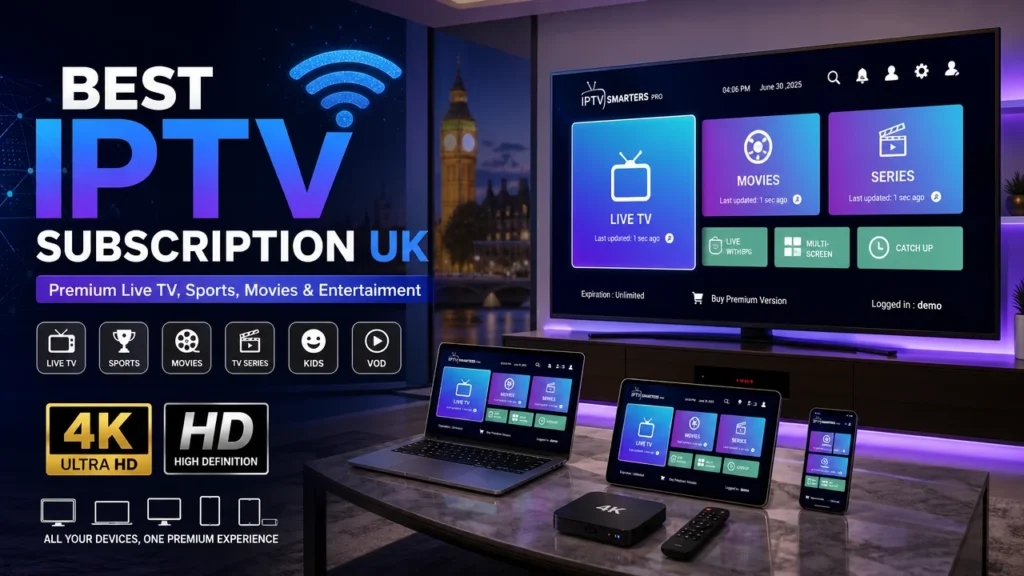
The image above captures what a quality IPTV dashboard looks like in practice. Notice how the interface resembles cable TV: a channel grid, a sports section, and a VOD library all live side by side. The magic is that every thumbnail and channel tile is loaded from a server over your internet connection — no antenna, no satellite dish, no coaxial socket in the wall.
Why People Switch to IPTV: Real Benefits
Millions of households now ask "is IPTV better than cable?" and the honest answer is: for most people, yes — with caveats. Here are the concrete advantages that drive that shift.
- Serious monthly savings. IPTV typically costs $10–$20 per month, compared to $60–$120 for cable. Even the most premium IPTV packages rarely exceed $20.
- Massive channel variety. A single subscription can include thousands of international channels, regional sports networks, news channels, and niche content that cable bundles sold separately.
- Multi-device flexibility. You aren't chained to one set-top box. IPTV apps run on Firestick, smart TVs, Android phones, iPhones, laptops, tablets, and media players — all with one account.
- Built-in VOD library. Most IPTV services bundle a large on-demand catalog of movies and TV series at no extra cost, reducing the need for expensive add-ons.
- Global access anywhere. Traveling with IPTV means all your channels travel with you. Open the app and watch your home-country news from anywhere on earth.
- No long-term contract. Month-to-month plans are the norm, so canceling is painless.
✅ What IPTV Does Well
- Costs 60–80% less than cable
- Live channels + VOD in one app
- Works on TV, phone, tablet, PC
- Global channel access
- No annual contract required
⚠️ IPTV's Honest Drawbacks
- Requires stable 10+ Mbps internet
- Legal gray area for some resellers
- Privacy varies by provider
- Peak-hour buffering possible
- Customer support inconsistent
Unlock complete high-definition information and priority access packs.
Claim This Special Offer for how does iptv work →Honest Limitations You Need to Know
No streaming technology is perfect, and IPTV's weaknesses are important to understand before you hand over any money.
Internet dependency is the biggest one. Your experience is only as good as your broadband. If your connection drops or your Wi-Fi is weak, the stream freezes. Cable and satellite remain more resilient when the internet flickers.
Legal gray areas exist. While IPTV technology itself is perfectly legal, many providers redistribute premium channels without proper licensing. In the US, the FCC and copyright holders have targeted some major unlicensed IPTV operations. Consumers are rarely prosecuted, but the moral and legal ambiguity is real. Always check whether your provider holds the rights to what they stream.
Quality varies wildly between providers. The "you get what you pay for" rule applies hard here. Cheap $5-a-month services often suffer from broken streams, missing EPGs, frequent downtime, and zero support. The IPTV review Reddit 2025 threads make this difference painfully clear: users talk about providers who vanish overnight versus providers who've been stable for years.
IPTV vs Cable vs Satellite vs Streaming Apps
The chart below gives a side-by-side comparison of the four ways you can watch TV at home. It's the same breakdown you'd find in any good IPTV vs cable debate, expanded to include satellite and on-demand apps.
| Feature | IPTV | Cable | Satellite | Streaming Apps |
|---|---|---|---|---|
| Monthly Cost | $10–$20 | $60–$120 | $70–$150 | $8–$20 per app |
| Internet Required | Yes — 10+ Mbps recommended | No | No | Yes |
| Live TV Channels | Thousands | 100–300 typical | 100–400 typical | Limited or none |
| Contract Term | Month-to-month | 1–2 years | 1–2 years | Month-to-month |
| Device Support | TV, phone, tablet, PC, box | Set-top box only | Satellite receiver only | Unlimited devices with logins |
| On-Demand Library | Included with most plans | Extra cost | Extra cost | Core feature |
| Weather Sensitivity | None | None | High | None |
| Setup Complexity | Moderate — once configured, simple | Professional install | Professional install | Very easy |
Long story short: if you want live sports and linear channels at a fraction of cable's cost, IPTV wins. If you want the absolute simplest app-based experience and don't need live channels, a streaming app like Netflix or Hulu is simpler. If you want reliability without internet dependency, cable or satellite still hold up — but you'll pay a premium for that comfort.
Who Should Switch to IPTV?
IPTV is not for everyone, and that's a healthy way to approach it. Let's be honest about who benefits most.
Cord-cutters looking to save $600+ a year. If you're already paying for cable and rarely watch it, IPTV gives you 10 times the content at a tenth of the price.
Sports fans. The best IPTV service for live sports delivers regional sports networks, international leagues, and pay-per-view events that cable typically packages at a high premium. If you follow multiple leagues across different countries, IPTV is nearly unbeatable.
International families. Want the news from India, soap operas from Mexico, and football from the UK — all in one subscription? IPTV was built for that.
Binge-watchers and VOD lovers. Most IPTV subscriptions bundle a massive on-demand library. If you're already paying for three streaming apps and a live TV package, IPTV can consolidate all of it.
Tech-comfortable people. IPTV setup isn't difficult, but it is a DIY experience. If the phrase "enter your M3U playlist URL" sounds like a chore, IPTV may frustrate you. If it sounds like a Tuesday, you'll love it.
How to Get Started: 7 Practical Steps
Ready to try IPTV for yourself? Follow these steps in order, and you'll be watching your first stream within the hour.
- Run a speed test. You want at least 10 Mbps download for stable HD streaming, and 25+ Mbps for 4K. Open speedtest.net and check both download speed and latency. Under 5 Mbps, IPTV will be a frustrating experience.
- Pick a reputable provider. Don't gamble with random Telegram sellers. Look for where to buy reliable IPTV subscription advice from real users on forums like Reddit, and start with a service that offers a trial or monthly plan. The provider featured in the offers within this article is a solid starting point because it backs its service with transparent pricing and multi-device support.
- Choose your device. The three easiest starting points are a Firestick 4K, an Android TV box, or a smart TV running the IPTV Smarters or TiviMate app.
- Install the player app. On Firestick, use the Downloader app to install a player like TiviMate or IPTV Smarters. On smart TVs, search the built-in app store. On Android, download from Google Play.
- Enter your playlist or portal. Your provider sends an M3U URL or portal login after purchase. Drop it into the app's settings. The channel list and EPG usually appear within a minute.
- Customize the channel list. Favor your most-watched channels, hide the ones you'll never touch, and set the EPG timezone to your region.
- Test during peak hours. Try watching a major sporting event at 8 p.m. on a Saturday. If it buffers hard, check your router's QoS settings, try a wired ethernet connection, or consider a VPN to bypass potential ISP throttling. This is the essence of every good IPTV buffering fix guide.
Final Subscription Window:
Main Offer Today →Affiliate Disclosure: Clicking this secure link verified by our network supports our team through standard partnership terms at zero extra cost to your invoice.
Frequently Asked Questions
1. How does IPTV work on a smart TV?
Most modern smart TVs have an app store where you can install an IPTV player like Smart IPTV, IPTV Smarters, or a provider's custom app. Once installed, you enter the M3U playlist URL or portal credentials that your IPTV subscription provides. The app connects to the provider's server, downloads the channel list and electronic program guide, and streams whatever channel you select directly over your home internet. No extra hardware is needed if your TV is connected to Wi-Fi or an ethernet cable.
2. Is IPTV legal in the US?
IPTV technology is completely legal — the same protocol powers corporate video platforms and hotel television systems nationwide. The legality question comes down to the content, not the technology. Many IPTV providers stream premium channels without proper retransmission rights, which makes their distribution illegal. In the US, consumers who stream unlicensed content are very rarely prosecuted, but the risk is not zero. The safest route is to choose a provider that holds licenses or only distributes freely available content. Always do your due diligence on the service you plan to pay.
3. What is the best IPTV service for live sports in 2026?
The best IPTV service for live sports varies depending on the leagues you follow, whether you need international coverage, and your budget. Top-rated services typically include ESPN, Fox Sports, beIN Sports, DAZN, and regional networks in their packages at a much lower price than traditional cable. When evaluating a provider, pay attention to advertised 4K sports streams, anti-freeze server technology, and 24/7 customer support. The strongest move is to use a free trial or a one-month plan during a live match you care about. If the stream holds up on a Saturday night, that provider earned your trust.
4. How do I set up IPTV on a Firestick?
Setting up IPTV on a Firestick takes about five minutes. Go to Settings > My Fire TV > Developer Options and enable "Install Unknown Apps." Then install the Downloader app from the Amazon App Store and use it to download an IPTV player such as TiviMate or IPTV Smarters. After installing the player, open it and enter the M3U URL or portal login details that your IPTV provider emailed you. The channel list and guide populate automatically. This is the same basic process whether you're using a Firestick Lite, 4K, or the latest Fire TV Cube.
5. IPTV vs cable — which is better?
IPTV wins on price, channel variety, and device flexibility; cable wins on reliability and simplicity. If you have solid internet and you're comfortable configuring an app, IPTV is the better value by a significant margin. If you want a service that "just works" with professional installation and no dependence on your broadband, cable is still dependable — but you'll pay triple the price for the privilege. The deciding factor is fast internet; with a stable 25+ Mbps connection, IPTV has very few meaningful downsides.
6. Where can I buy a reliable IPTV subscription?
Finding a reliable IPTV subscription is the hardest part of the whole experience. Many services that look polished on social media are one-month-old resellers using the same unstable sources. Start with services that have a year or more of consistent uptime, transparent pricing, a free trial or 3-day demo, and responsive support via email or Discord. Search for "where to buy reliable IPTV subscription" on Reddit and read recent experiences rather than relying on sponsored reviews. Also check the provider's uptime over a few days before committing to a long payment plan.
7. How do I fix IPTV buffering?
Buffering is the most common IPTV complaint, and the fix usually falls into one of three buckets. First, improve your network: use an ethernet cable instead of Wi-Fi, move your router closer to your streaming device, or turn off other devices hogging bandwidth. Second, adjust the stream's bitrate or resolution in the player settings — 1080p or 720p often looks nearly identical to 4K on smaller screens and eliminates stuttering. Third, use a VPN to bypass ISP throttling. Many ISPs intentionally slow down streaming traffic; a VPN encrypts your traffic and hides what you're watching. Also consider restarting your router and updating your player app when buffering becomes persistent.
8. What do IPTV reviews on Reddit say in 2025?
Across subreddits like r/IPTV and r/cordcutters, the 2025 consensus is that IPTV remains the best way to get the most channels for the least money, but provider research is essential. Users consistently warn against buying annual plans from unverified sellers, recommend looking for services with free trials and active communities, and note that even top providers occasionally have server hiccups during peak major events. Reddit reviews in 2025 also highlight how much the "good provider" standard has risen: stable 4K streams, reliable EPG metadata, and fast customer support are now table stakes among the best services.
If you're still unsure where to begin, that's a healthy reaction to a crowded market. The provider linked throughout this guide is one of the few that consistently passes the reliability bar set by veteran IPTV users: multi-day free trials, transparent monthly pricing, stable servers across peak sports hours, and support inboxes that actually reply in minutes rather than days. You can explore the offer here — or save this article and come back when you're ready to cut the cord for good.